CC1 -- Support Manual
Autonomous multi-function cleaning robot for small and medium-sized indoor environments, combining scrubbing, sweeping, vacuuming, and dust mopping in a single platform.
Page 1: Overview
What is the CC1?
The CC1 is a versatile autonomous cleaning robot built for routine maintenance of indoor commercial spaces. It integrates four cleaning functions -- scrubbing, sweeping, carpet vacuuming, and dust mopping -- into one machine, allowing facilities teams to handle multiple floor types and soiling levels without switching between dedicated units.
The CC1 is designed for small and medium-sized indoor environments such as office buildings, hotels, retail stores, shopping centres, and other spaces that require regular light-to-medium cleaning on hard floors or low-pile carpet. It navigates autonomously using integrated LiDAR and visual SLAM, following pre-mapped routes and returning to its docking station for charging, water filling, and water draining without manual intervention.
With a 15-litre solution tank, 15-litre recovery tank, and battery life ranging from 4 to 9 hours depending on the cleaning mode, the CC1 can cover between 700 and 1,000 square metres per hour. It supports fully automated operation when paired with the optional docking station and configured with scheduled tasks.
At a Glance
| Detail | Value |
|---|---|
| Model | CCBC01 |
| Cleaning Functions | Scrubbing, sweeping, vacuuming, dust mopping |
| Battery Life | 4--9 hours (mode dependent) |
| Cleaning Coverage | 700--1,000 sq m/h |
| Solution Tank | 15 L |
| Recovery Tank | 15 L |
| Dustbin | 2.5 L |
| Weight | 75 kg |
| Navigation | LiDAR + Visual SLAM |
| Floor Types | Hard floors and short-pile carpet |
Page 2: Specifications
| Feature | Value |
|---|---|
| Model | CCBC01 |
| Operating Voltage | DC 23 V -- 29.2 V |
| Power Input | AC 100 V -- 240 V, 50/60 Hz |
| Power Output | 29.2 V, 15 A |
| Battery Capacity | 50 Ah |
| Charging Time | Less than 3 hours |
| Battery Life -- Scrubbing | Approximately 5 hours |
| Battery Life -- Sweeping + Vacuuming + Mopping | Approximately 5 hours |
| Battery Life -- Carpet Vacuuming | Approximately 4 hours |
| Battery Life -- Silent Mopping | Approximately 9 hours |
| Weight | 75 kg (165.35 lbs) |
| Dimensions (L x W x H) | 629 x 552 x 695 mm |
| Screen | 10.1-inch LCD |
| Navigation | Integrated LiDAR and visual SLAM |
| Speed Range | 0.2 -- 1.2 m/s (adjustable) |
| Working Noise | Less than 70 dB |
| Min Path Clearance | 70 cm (75 cm preferred) |
| Min Turning Width | 88 cm |
| Min Height Clearance | 76 cm |
| Max Surmountable Height | 20 mm (pass-through); 8 mm (while cleaning) |
| Max Surmountable Gap | 35 mm |
| Max Climbing Angle | 8 degrees (non-cleaning); 3 degrees (while cleaning) |
| Cleaning Width (with side brush) | 500 mm |
| Squeegee / Mopping Width | 630 mm |
| Carpet Vacuum Nozzle Width | 515 mm |
| Cleaning Efficiency | 700 -- 1,000 sq m/h |
| Dustbin Capacity | 2.5 L |
| Solution Tank | 15 L |
| Recovery Tank | 15 L |
| Water Usage | 3--7.2 L/h (depending on water speed setting) |
| OS | Android |
| Connectivity | 4G, Wi-Fi, Bluetooth, LoRa (optional) |
| Mobile App | Supported |
| Operation Mode | Manual / Automatic / Scheduled |
| Auto Charging and Water | Supported (with docking station) |
| Working Temperature | 1 to 40 C |
| Storage Temperature | -20 to 60 C |
| Humidity | 85% RH or less |
| Working Altitude | Below 2,000 m |
| Floor Types | Terrazzo, marble, tiles, epoxy resin, sandstone, artificial stone, short-pile carpet |
| IP Rating | IPX4 |
| Enclosure Material | PC + ABS |
Page 3: Product Components
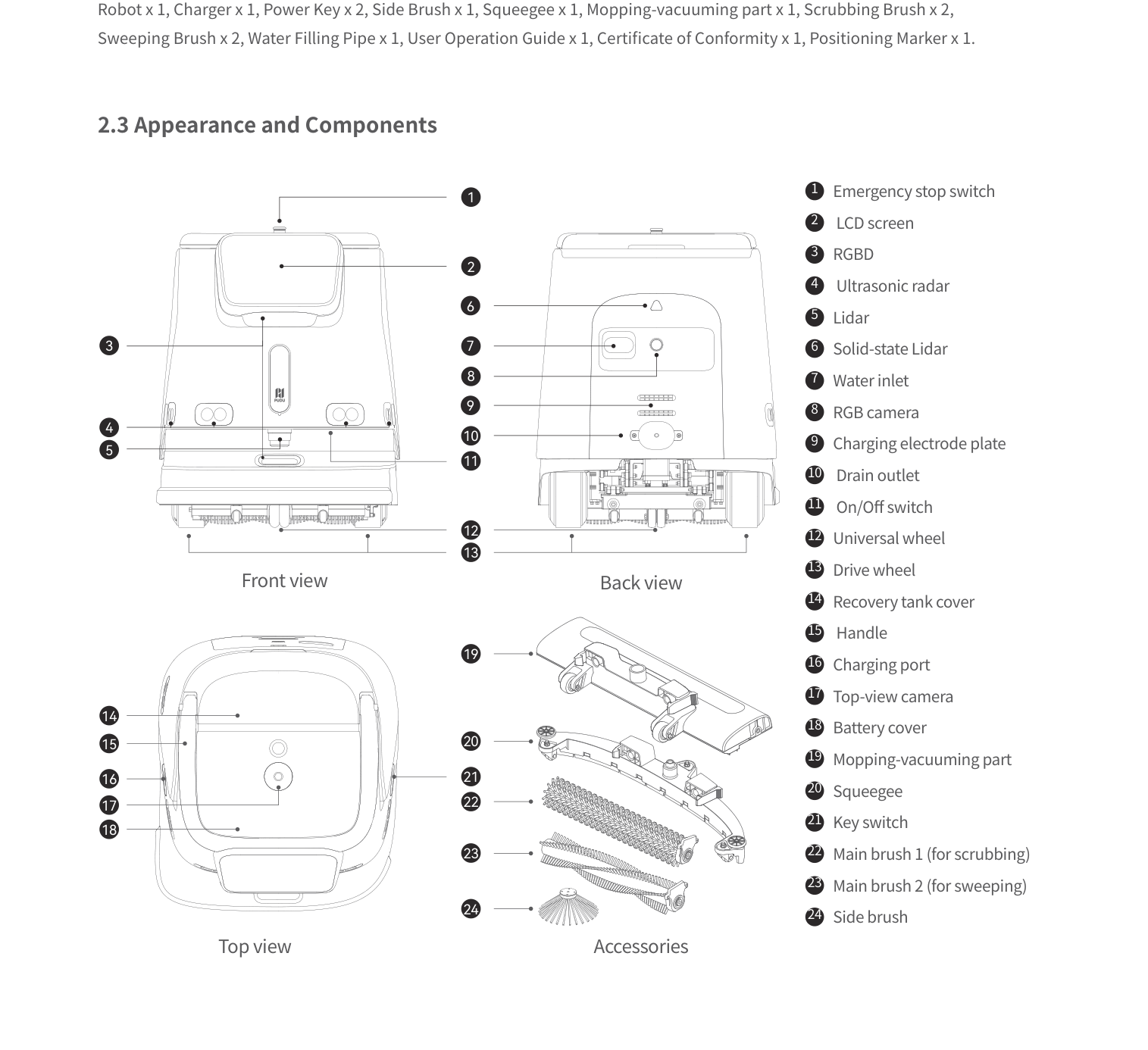
External Components
- Emergency stop switch
- 10.1-inch LCD screen
- Handle (raises/lowers with screen)
- Key switch
- On/Off power switch
- Charging port
- Water inlet
- Drain outlet
- Recovery tank cover
- Battery cover
Sensors and Navigation
- LiDAR
- Solid-state LiDAR
- RGBD sensor
- RGB camera
- Top-view camera
- Ultrasonic radar
The CC1 uses integrated LiDAR and visual SLAM for autonomous navigation. Before starting an automatic task, the robot must be placed below or in front of the visual positioning marker.
Cleaning Components
- Scrubbing brush (Main brush 1) -- used in Scrubbing mode
- Sweeping brush (Main brush 2) -- used in Sweeping, Carpet Vacuuming, and Silent Mopping modes
- Side brush -- used in all modes except Scrubbing
- Squeegee -- collects dirty water during scrubbing; must be checked before each use
- Mopping-vacuuming part -- used in Sweeping and Silent Mopping modes
- Dustbin (2.5 L) -- collects dry debris during sweeping and vacuuming
- Washing filter -- placed in recovery tank during scrubbing
- Solution tank (15 L) -- holds clean water and detergent
- Recovery tank (15 L) -- collects dirty water
- Water filter chamber -- inside recovery tank; requires regular cleaning
Ports and Interfaces
- Charging electrode plate -- for docking station connection
- Universal wheel
- Drive wheel
Page 4: Safety Instructions
Before You Start
- Read the full manual before operating the CC1.
- Only trained personnel should operate this machine.
- The CC1 is designed for indoor use only. Do not use outdoors, on open balconies, or on rugged ground.
- Clear all cables, loose wires, and floor obstacles from the cleaning area before starting.
Electrical Safety
- Use only the original charger. Replace damaged chargers immediately with genuine parts.
- Fully charge the battery to 100% before first use.
- Keep the battery level above 10% during regular operation. Below 2%, the battery enters protection mode and the robot stops all functions.
- Turn the key switch to the off position during extended periods of non-use.
- After prolonged storage, fully charge the battery before using the robot again.
Operating Safety
- Do not pull or push the robot backward while it is powered on.
- Do not block or cover any sensors during operation.
- Do not adjust settings while the robot is moving -- pause via the screen first.
- Do not clean or perform maintenance on the robot while it is powered on.
- Maximum recommended operating speed is 1.2 m/s.
- The minimum turning width is 88 cm; the minimum height clearance is 76 cm.
Water and Chemical Safety
- Use a non-foaming or low-foaming cleaning solution with a pH range of 6--8. Recommended pH range is 6.5--7.5.
- Do not use strong acids, strong alkalis, or flammable substances in the solution tank.
- Avoid cleaning solutions containing limonene, as it can react with and damage plastic components.
- An anti-foaming agent can be added if needed.
- Diversey brand cleaning solution is recommended by the manufacturer.
- Empty both the solution tank and recovery tank before transporting the robot.
- Never tip the machine with water inside the tanks.
Environmental Requirements
- Operating temperature: 1 to 40 C.
- Storage temperature: -20 to 60 C.
- Humidity: 85% RH or less.
- Working altitude: below 2,000 m.
- Do not use in areas with fire or explosion risk.
- Not suitable for heavily greasy floors.
Warnings
- Maximum protrusion height for cleaning is 8 mm; for passing through without cleaning is 20 mm.
- Do not use on slopes greater than 3 degrees while cleaning.
- The CC1 has a blind spot in the rear right area, especially during turns. Use virtual walls or no-go zones to protect fragile walls and furniture in tight areas.
Page 5: Basic Operation
Powering On
- Turn the key switch to the on position.
- Press and hold the power button for approximately 3 seconds.
- The bottom LED strip turns blue, confirming the robot is on.
- The 10.1-inch LCD screen displays the home screen.
Powering Off
- Press and hold the power button for approximately 6 seconds.
- Wait until the screen turns off completely.
- For extended storage, turn the key switch to the off position.
Pausing Operation
- Tap the LCD screen to pause the robot mid-task.
- Tap again to resume operation.
Emergency Stop
- Press the red emergency stop switch on top of the robot firmly to halt all movement immediately.
- Once the situation is resolved, rotate the emergency stop switch clockwise to release it.
- Follow the on-screen instructions to resume normal operation.
Use the emergency stop only in urgent situations. For routine pausing, tap the screen instead.
Moving the Robot Manually
- Raise the handle (connected to the screen).
- Push the robot from behind using the handle.
- Do not pull or push the robot backward while powered on.
- Lower the handle when the robot is idle or running an automatic task.
Handle Operation
The handle is connected to the LCD screen assembly. Raise the handle when pushing the robot or interacting with the touchscreen. Lower the handle before starting any automatic cleaning task -- failure to lower the handle may prevent the task from starting.
Working Modes
Manual Cleaning: From the home screen, tap "Manual Cleaning," select the mode (mopping or sweeping), tap "Start," and push the robot with the handle raised.
Automatic Cleaning: Position the robot below or in front of the visual positioning marker. From the home screen, tap "Auto-Cleaning," select the desired task, and tap "Start." Lower the handle before the task begins.
Scheduled Task: Configure scheduled tasks through the on-screen interface. The robot executes tasks at the designated time automatically, provided it is properly positioned, has sufficient battery, and adequate water. If the start time of a second task is reached while the first is still running, the second task is skipped.
Assist Mode: Activated from the "More" button on the home screen. Allows manual guidance of the CC1 during cleaning for complex or tight areas.
Page 6: Charging and Battery
Charging Methods
The CC1 supports two charging methods:
- Manual charging -- Connect the original charger to the charging port on the robot.
- Docking station charging -- The robot docks automatically with the optional docking station for hands-free charging.
Docking Station
The optional docking station (workstation) provides three automated functions:
- Auto-charging -- The robot returns and charges when battery is low.
- Auto water filling -- Clean water is automatically supplied to the solution tank.
- Auto water draining -- Dirty water is automatically drained from the recovery tank.
Automatic return conditions: The CC1 returns to the docking station when any of these conditions are met: - Battery level drops below 10% - Fresh water level falls below 5% - Recovery tank becomes full
If battery drops below 5%, the robot is forced to return regardless of task status. The robot estimates the power required to finish current tasks and recharges to that level.
Docking station placement: Ensure at least 1 metre of clear space in front of the station. Keep charging electrode plates clean on both the robot and station.
Battery Information
| Detail | Value |
|---|---|
| Type | Lithium battery, 50 Ah |
| Operating Voltage | DC 23 V -- 29.2 V |
| Charging Time | Less than 3 hours |
| Scrubbing Runtime | Approximately 5 hours |
| Sweeping + Vacuuming + Mopping Runtime | Approximately 5 hours |
| Carpet Vacuuming Runtime | Approximately 4 hours |
| Silent Mopping Runtime | Approximately 9 hours |
Charging Indicators
- Bottom LED strip turns blue when the robot is powered on.
- Battery level is displayed on the LCD screen.
- When battery drops below 10%, the robot signals low battery.
- Below 2%, protection mode activates and the robot stops all operations.
Battery Care Tips
- Always fully charge before first use.
- Keep the battery above 10% during normal operation.
- Charge promptly when the robot signals low battery.
- Turn the key switch off during extended storage.
- Fully charge the battery before using the robot after prolonged storage.
- Consistently running the battery below 10% reduces overall battery lifespan.
Page 7: Cleaning Modes and Functions
Scrubbing Mode
Purpose: Deep cleaning of hard floor surfaces using water and detergent.
Setup: 1. Install the scrubbing brush. 2. Install the squeegee. 3. Place the washing filter in the recovery tank. 4. Remove the side brush. 5. Fill the solution tank with water and approved cleaning solution.
Best for: Terrazzo, marble, tiles, epoxy resin, sandstone, artificial stone -- any hard floor requiring wet scrubbing.
Sweeping Mode
Purpose: Combined sweeping, vacuuming, and dust mopping for hard floors.
Setup: 1. Install the side brush. 2. Install the sweeping brush. 3. Install the mopping-vacuuming part. 4. Place the vacuum dustbin in the recovery tank. 5. Ensure the recovery tank is empty (no water).
Best for: Daily maintenance of hard floors with light dust and dry debris.
Carpet Vacuuming Mode
Purpose: Sweeping and vacuuming for low-pile carpets.
Setup: 1. Install the side brush. 2. Install the sweeping brush. 3. Install the carpet sweeper. 4. Place the vacuum dustbin in the recovery tank. 5. Ensure the recovery tank is empty.
Note: Sweeping brushes can optionally be disabled for vacuum-only operation. The carpet vacuum nozzle width is 51.5 cm. Not suitable for thick, high-pile, or shag carpets.
Best for: Low-pile commercial carpet in offices, hotels, and retail spaces.
Silent Mopping Mode
Purpose: Low-noise cleaning for noise-sensitive environments.
Setup: 1. Install the side brush. 2. Install the sweeping brush. 3. Install the mop head. 4. The blower is turned off automatically in this mode.
Best for: Hotels, offices, shopping centres, and lobbies during business hours. Provides the longest battery life at approximately 9 hours.
Additional Features
Breakpoint Resume: If a task is paused, cancelled, or the robot returns to the docking station due to low battery or water, the CC1 records the interruption position. On the next cleaning operation, it navigates back to that position and resumes from where it left off.
Obstacle Handling: When the CC1 encounters a narrow space or blocking obstacle, it explores left, right, or reverses (up to 30 cm) to find a way through. If stuck for more than 30 seconds, it re-plans and generates a new path to a different cleaning area.
Auto-Return: The robot automatically returns to the docking station when battery drops below 10%, fresh water drops below 5%, or the recovery tank is full.
Scheduled Tasks: Configure the robot to execute cleaning tasks at specific times. The robot must be properly positioned with sufficient battery and water.
App Control: The CC1 supports mobile app connectivity via 4G, Wi-Fi, and Bluetooth for remote monitoring and task management.
Page 8: Water System and Cleaning Solution
Clean Water Tank (Solution Tank)
- Capacity: 15 litres
- Purpose: Holds clean water and cleaning solution for dispensing during scrubbing mode.
- Maintenance: Empty remaining solution after each scrubbing session. Rinse if needed.
Dirty Water Tank (Recovery Tank)
- Capacity: 15 litres
- Purpose: Collects dirty water via the squeegee and vacuum system during scrubbing.
- Maintenance: Flush with clean water every 2--3 days. Drain dirty water completely. Clean the water filter chamber inside the recovery tank to remove accumulated dirt.
Filling and Draining
Manual filling: Open the solution tank and fill with clean water and approved cleaning solution.
Manual draining: Open the drain outlet and empty the recovery tank. Remove blockages from the drain pipe if needed.
Automatic (with docking station): - Auto-fill replenishes the solution tank with clean water. - Auto-drain empties the recovery tank of dirty water.
Always empty both tanks before transporting the robot.
Cleaning Solution
- Use a non-foaming or low-foaming cleaning solution.
- pH range must be 6--8. Recommended range: pH 6.5--7.5.
- Do not use strong acids, strong alkalis, or flammable substances.
- Avoid solutions containing limonene (damages plastic components).
- An anti-foaming agent can be added if foam builds up.
- Diversey brand cleaning solution is recommended by the manufacturer.
- Always follow the detergent manufacturer's dilution instructions.
Water Usage Information
| Water Speed Setting | Approximate Usage per Hour |
|---|---|
| Low | 3.0 L/h |
| Medium | 4.8 L/h |
| High | 7.2 L/h |
At minimum cleaning efficiency of 700 sq m/h, water usage per square metre is approximately 10 mL.
Page 9: Maintenance and Servicing
Maintenance Schedule
| Component | Frequency | Method |
|---|---|---|
| Scrubbing brush | Before each use | Inspect for wear; replace if bristles are severely worn or flattened |
| Sweeping brush | Before each use | Inspect for wear; replace if severely worn |
| Side brush | Before each use | Inspect for damage, tangling, or wear |
| Squeegee | Before each use | Inspect for wear, deformation, or debris; clean after each scrubbing session |
| Solution tank | After each scrubbing session | Empty remaining solution; rinse if needed |
| Recovery tank | Every 2--3 days | Flush with clean water, then drain dirty water completely |
| Dustbin | Every 2--3 days | Empty contents; wash with clean water if needed, then dry |
| Water filter chamber | Every 2--3 days | Rinse with clean water to remove accumulated dirt |
| Drive wheels and auxiliary wheels | Weekly | Wipe surfaces with a clean cloth |
| Vision sensors and LiDAR | Weekly | Clean with a soft cloth or lens cleanser |
| Charging electrode plates | Monthly | Wipe with a dry cloth to ensure good contact |
Replacing Consumables
General replacement cycle: Inspect every 2 days. Replace brushes, squeegee rubber strips, filters, mopping-vacuuming part mop, side brush, and filter cartridge approximately every 3 months. Actual frequency depends on cleaning conditions and usage intensity.
Brushes: 1. Power off the robot via the key switch. 2. Turn the robot over or access the underside. 3. Remove the worn brush assembly. 4. Install the new brush, ensuring it seats properly. 5. The CC1 ships with 2 scrubbing brushes and 2 sweeping brushes. 6. Always use genuine replacement parts.
Squeegee rubber strips: 1. Remove the squeegee from the robot. 2. Inspect the rubber strips for wear, tears, or deformation. 3. Replace with new strips if worn. Clean the squeegee suction hose at the same time. 4. Reinstall the squeegee securely.
Dustbin and filters: 1. Remove the dustbin from the recovery tank slot. 2. Empty all contents. 3. Wash with clean water if needed and dry completely before reinstalling. 4. Check and clean the water filter chamber inside the recovery tank.
Cleaning the Robot
- Wipe the robot body with a clean cloth.
- Do not use water pressure cleaners.
- Do not immerse the robot in water.
- Clean all sensors with a soft cloth or lens cleanser weekly.
Docking Station Maintenance
- Clean electrode plates on both the robot and station monthly with a dry cloth.
- Ensure clear space (at least 1 metre) in front of the station at all times.
- Verify the station has not been moved from its mapped position.
When to Replace Parts
| Sign | Action |
|---|---|
| Brush bristles flattened, missing, or severely worn | Replace brush assembly |
| Squeegee rubber is torn, deformed, or leaves streaks | Replace squeegee rubber strips |
| Dustbin cracked or filter permanently clogged | Replace dustbin or filter |
| Cleaning quality degrades despite clean components | Inspect all consumables; replace as needed |
| Suction reduced after cleaning dustbin and filter | Check vacuum motor; contact support if needed |
Medium Soiled Environment Tips
- Use a water filter box.
- Remove the air filter sponge and tightly cover the lid.
- Regularly wash the suction hose to prevent clogs.
- Adjust suction power to the highest level.
- Use mild cleaning agents that are non-acidic and non-alkaline.
Page 10: Troubleshooting
Robot will not power on
What you see: No response when pressing the power button. Screen stays dark, no LED activity.
Likely causes: Key switch is off; battery is fully depleted (below 2%); charger or battery fault.
What to check: 1. Verify the key switch is turned to the on position. 2. Press and hold the power button for at least 3 seconds. 3. Check if the bottom LED strip shows any colour. 4. If no response, connect the original charger and check charger indicator lights.
Solution: Turn the key switch on and retry. If the battery is depleted, charge for at least 30 minutes before attempting to power on. If the charger shows no activity, try a different outlet. Replace a damaged charger with an original charger only.
Escalate if: The robot does not power on after confirming key switch is on and battery is charged.
Robot does not charge or charges very slowly
What you see: Battery level does not increase when connected to charger. Charging takes significantly longer than 3 hours.
Likely causes: Damaged or non-original charger; dirty charging contacts; battery at end of life; power outlet issue.
What to check: 1. Confirm you are using the original charger. 2. Test the power outlet with another device. 3. Inspect the charging port and electrode plates for dirt or damage. 4. Clean contacts with a dry cloth.
Solution: Replace the charger if damaged. Clean charging contacts and retry. If using the docking station, ensure electrode plates on both robot and station are clean and aligned.
Escalate if: Battery does not charge with a confirmed working charger and clean contacts. The battery may need replacement.
Navigation or positioning failure
What you see: Robot veers off path, stops unexpectedly, or displays positioning errors on screen.
Likely causes: Dirty LiDAR or vision sensors; positioning marker missing, moved, or damaged; environment changed since mapping; robot started from wrong location.
What to check: 1. Clean LiDAR and all camera sensors with a soft cloth or lens cleanser. 2. Verify the positioning marker is in its correct location and undamaged. 3. Ensure the robot was placed below or in front of the marker before starting. 4. Check if the environment layout has changed significantly.
Solution: Clean all sensors and retry. Reposition the robot near the visual marker. If the environment has changed (moved furniture, new walls), remap the area.
Escalate if: Navigation consistently fails after sensor cleaning and proper positioning. Sensor hardware may be faulty.
Robot unable to clean (no scrubbing/sweeping action)
What you see: Robot moves but does not scrub, sweep, or vacuum. Floor remains dirty after the robot passes.
Likely causes: Wrong brush installed for the selected mode; dustbin is full; brush is severely worn; wrong mode selected.
What to check: 1. Verify the correct brushes and attachments are installed for the selected cleaning mode. 2. Remove and check the dustbin; empty if full. 3. Inspect the brush for severe wear or tangling. 4. Confirm the correct cleaning mode is selected on the touchscreen.
Solution: Install the correct brush assembly for the desired mode. Empty the dustbin. Replace severely worn brushes.
Escalate if: The robot still does not clean after verifying all attachments and the dustbin. The brush motor or suction system may be faulty.
Water not dispensing during scrubbing
What you see: Robot runs in scrubbing mode but no water reaches the floor.
Likely causes: Solution tank empty; tank not properly seated; water inlet or pipe blockage; wrong mode selected.
What to check: 1. Check if the solution tank has water. Refill if empty. 2. Remove and reseat the solution tank to ensure proper connection. 3. Inspect the water filling pipe for blockages or kinks. 4. Verify the robot is set to Scrubbing mode on the screen.
Solution: Refill the solution tank with clean water and approved cleaning solution (pH 6--8, non-foaming). Clear any blockage in the water line. Ensure the tank is fully seated.
Escalate if: Water does not dispense with a full, properly seated tank and clear lines. The water pump may be faulty.
Unable to drain dirty water
What you see: Recovery tank does not empty during auto-drain cycle or manual drain.
Likely causes: Drain pipe blocked with dirt or debris; recovery tank not properly positioned; docking station drain hose disconnected.
What to check: 1. Inspect the drain outlet for visible blockages. 2. Remove debris from the drain pipe. 3. Check that the recovery tank is properly installed. 4. If using the docking station, verify the drain hose connection.
Solution: Clear blockages and rinse the recovery tank with clean water. Reseat the recovery tank with the cover secure. Manually empty the tank if auto-drain continues to fail.
Escalate if: The drain system remains blocked after thorough cleaning. Internal plumbing may be damaged.
Poor cleaning quality or streaks on floor
What you see: Visible wet streaks, dirty lines, or missed spots after scrubbing.
Likely causes: Squeegee worn, deformed, or dirty; recovery tank suction reduced (full tank or blocked filter); brush worn; incorrect detergent (too foamy).
What to check: 1. Remove and inspect the squeegee for wear, tears, or deformation. 2. Clean the squeegee and remove trapped debris. 3. Check the recovery tank level and empty if near full. 4. Inspect and clean the water filter chamber. 5. Check the scrubbing brush for wear.
Solution: Clean or replace the squeegee. Empty the recovery tank and clean the filter. Replace worn brushes. Ensure the correct non-foaming cleaning solution is used (pH 6--8).
Escalate if: Streaks persist after all components are clean and correctly installed. The suction system may need servicing.
Residual water on floor after scrubbing
What you see: Puddles or wet spots remain after the robot completes a scrubbing task.
Likely causes: Floor surface has wide gaps; water left on squeegee rubber strips; blocked suction hose; recovery tank full.
What to check: 1. Inspect the squeegee and rubber strips for cleanliness and proper installation. 2. Check the suction hose for blockages. 3. Verify the recovery tank is not full. 4. Check if the floor has wide gaps or uneven joints where water pools.
Solution: Regularly maintain the robot to prevent suction hose clogging. Clean squeegee rubber strips after each use. Ensure the designated water collection area has no floor gaps. The robot performs back-and-forth motion in the collection area to vacuum remaining water.
Escalate if: Residual water persists after confirming suction system and squeegee are clean and properly installed.
Unusual noise during operation
What you see: Grinding, rattling, or unusually loud sounds beyond the normal 70 dB level.
Likely causes: Foreign object in brush or wheels; brush not properly seated; wheels dirty or obstructed; loose components.
What to check: 1. Power off the robot via the key switch. 2. Inspect the underside for foreign objects around brushes and wheels. 3. Verify all brushes are properly installed and seated. 4. Check that the squeegee is correctly attached. 5. Inspect drive and universal wheels for debris.
Solution: Remove foreign objects. Reseat brushes and squeegee firmly. Clean wheel surfaces.
Escalate if: Unusual noise continues after clearing all obstructions. Internal motor or gearbox issues may exist.
Excessive noise in quiet environments
What you see: Robot is noticeably loud in offices, shopping centres, or hotel lobbies.
Likely causes: High suction power mode selected; brush speed set too high.
What to check: 1. Note the current suction and brush speed settings. 2. Check the selected cleaning mode. 3. Determine if Silent Mopping mode could be used instead.
Solution: Reduce suction power and brush speed settings. Use Silent Mopping mode in noise-sensitive environments. Schedule cleaning during off-peak hours. Organise the sequence so the water collection phase occurs in unoccupied areas.
Escalate if: Not typically a fault. Resolved by adjusting settings and scheduling.
Robot stops unexpectedly during task
What you see: Robot halts mid-task without completing the cleaning route.
Likely causes: Low battery (below 10%); immovable obstacle; emergency stop accidentally pressed; sensor blockage.
What to check: 1. Check the battery level on the screen. 2. Look for obstacles in the robot's path. 3. Verify the emergency stop switch is released (rotate clockwise). 4. Check that no sensors are blocked or covered. 5. Review error messages on the LCD screen.
Solution: Charge if battery is low. Remove obstacles. Release the emergency stop and follow screen prompts. Clean dirty sensors.
Escalate if: The robot stops repeatedly with no visible cause and sufficient battery.
Dustbin full warning or reduced suction
What you see: Robot displays dustbin full alert, or suction power noticeably decreases.
Likely causes: Dustbin full; dustbin filter clogged; dustbin not properly reinstalled.
What to check: 1. Remove the dustbin and check the fill level. 2. Empty the contents. 3. Wash with clean water if necessary and dry completely. 4. Reinstall, ensuring it clicks into place.
Solution: Empty and clean the dustbin regularly (every 2--3 days or more often in heavy-use environments). Check for filter blockages.
Escalate if: Suction remains poor after emptying and cleaning. The vacuum motor may need inspection.
Robot cannot dock with station
What you see: Robot approaches the docking station but fails to connect, or repeatedly tries and backs off.
Likely causes: Dirty electrode plates; docking station moved from mapped position; obstacle near station; station power issue.
What to check: 1. Clean charging electrode plates on both robot and station with a dry cloth. 2. Verify the station has power. 3. Ensure clear space (at least 1 metre) in front of the station. 4. Check if the station was moved since mapping.
Solution: Clean electrode plates and retry. Clear the area around the station. Return the station to its mapped position or update the map.
Escalate if: Docking consistently fails after cleaning contacts and clearing the area.
Water leaking from the robot
What you see: Puddles forming under or around the robot during operation or while idle.
Likely causes: Recovery tank cover not sealed; solution tank not correctly seated; damaged seals; squeegee vacuum connection loose.
What to check: 1. Check that the recovery tank cover is fully closed and sealed. 2. Verify the solution tank is properly installed. 3. Inspect seals and gaskets for visible damage. 4. Ensure the squeegee vacuum connection is secure.
Solution: Reseat tank covers and solution tank. Replace damaged seals. Tighten all connections.
Escalate if: Leaking continues after verifying all tanks and connections are properly sealed. Internal seals may be damaged.
Scrapes and scratches on walls or furniture
What you see: The robot causes scrapes or scratches during turns.
Likely causes: Blind spot in the rear right area of the CC1, especially during left or right turns; obstacle avoidance does not fully include cleaning components in the avoidance range.
What to check: 1. Identify the areas where scrapes occur. 2. Check if these are near tight corners or narrow passages. 3. Review the cleaning route for areas with limited clearance.
Solution: Implement virtual walls or no-go zones in the cleaning map around prone areas. Ensure corridors provide at least 88 cm clearance for turns. Reposition furniture away from the turning path.
Escalate if: Scrapes occur in wide-open areas, suggesting a sensor calibration issue.
Page 11: Frequently Asked Questions
Getting Started
How wide a path does the CC1 need to navigate? At least 70 cm, with 75 cm or more preferred for long passages. The minimum turning width is 88 cm. The minimum height clearance is 76 cm.
Can the CC1 handle thresholds and small bumps? Yes -- up to 8 mm while cleaning and up to 20 mm when passing through without cleaning. It can cross gaps up to 35 mm wide.
Does the CC1 work outdoors? No. The CC1 is designed strictly for indoor use on flat surfaces within a temperature range of 1 to 40 C.
What is the cleaning coverage rate? 700 to 1,000 square metres per hour, depending on mode, speed, and floor layout.
How does the CC1 calculate cleaning area in reports? Cleaning width (500 mm) multiplied by active cleaning duration. Transition and pause time is excluded. Reports upload immediately after task completion; if offline, they upload on next startup.
Charging
How long does it take to fully charge? Less than 3 hours from empty to full using the original charger.
What is the battery life in different modes? Scrubbing: ~5 hours. Sweeping + vacuuming + mopping: ~5 hours. Carpet vacuuming: ~4 hours. Silent mopping: ~9 hours.
What happens if the battery drops below 10%? The robot signals low battery and should be charged promptly. Below 2%, protection mode activates and the robot stops all operations.
Does the CC1 have automatic docking and charging? Yes, when used with the optional docking station. It also supports auto water filling and auto water draining.
When does the CC1 automatically return to the docking station? When battery drops below 10%, fresh water drops below 5%, or the recovery tank is full. At below 5% battery, return is forced regardless of task status.
Cleaning Operations
What floors can the CC1 clean? Terrazzo, marble, tiles, epoxy resin, sandstone, artificial stone, and short-pile carpet.
Can the CC1 clean carpets? Yes, but only low-pile carpets in Carpet Vacuuming mode. Not suitable for thick or high-pile carpets.
How do I switch between cleaning modes? Change the physical brush attachments for the desired mode, then select the mode on the touchscreen.
Can the CC1 operate fully automatically? Yes, when used with a docking station and scheduled tasks configured. The robot executes tasks at designated times, returns to the station when needed, and resumes automatically.
Does the CC1 resume from where it left off after an interruption? Yes. It records the interruption position and navigates back to resume cleaning on the next task.
What is the assist mode? A manual-assist mode activated from the "More" button on the home screen, allowing an operator to guide the CC1 manually.
How does the CC1 handle getting stuck? It explores left, right, or reverses up to 30 cm to find a way through. If stuck for more than 30 seconds, it re-plans and generates a new path.
Water and Solution
How much water does the CC1 hold? 15 litres in the solution tank and 15 litres in the recovery tank.
How much water does the CC1 use per hour? Approximately 3 to 7.2 litres per hour depending on the water speed setting (low/medium/high).
What cleaning solution should I use? Non-foaming or low-foaming solution with pH 6--8 (recommended 6.5--7.5). Avoid limonene-containing solutions. Diversey brand is recommended by the manufacturer.
Safety
How do I use the emergency stop? Press the red emergency stop button firmly to halt all movement. Rotate clockwise to release. Follow on-screen instructions to resume.
What should I do before transporting the CC1? Empty both water tanks. Keep the robot upright. Never tip the machine during transport.
Maintenance
How do I clean the recovery tank? Flush with clean water every 2--3 days and drain completely. Rinse the water filter chamber inside to remove dirt.
When should I replace brushes? When visibly worn, flattened, or no longer cleaning effectively. Inspect before each use. Replace approximately every 3 months.
How often should components be replaced? Inspect every 2 days. Replace brushes, squeegee strips, filters, and mop parts approximately every 3 months depending on usage.
How noisy is the CC1? Less than 70 dB in standard operation. Silent Mopping mode is significantly quieter.
Page 12: Service and Escalation
When to Contact Support
- Robot does not power on after confirming key switch, battery, and charger are all functioning.
- Battery does not charge with a working original charger and clean contacts.
- Navigation fails consistently after sensor cleaning and proper positioning.
- Cleaning functions fail despite correct attachments and empty dustbin.
- Water pump does not dispense water with a full, properly seated tank.
- Drain system remains blocked after thorough cleaning.
- Suction remains poor after emptying and cleaning all filters and dustbin.
- Water leaking persists after reseating all tanks and checking seals.
- Unusual noise continues after removing all foreign objects and reseating components.
- Docking consistently fails after cleaning contacts and clearing the area.
- Any error message on the screen that you cannot resolve with the troubleshooting steps above.
Before You Call
Gather the following information before contacting support:
- Robot model and serial number (CCBC01).
- Description of the issue and when it started.
- Steps you have already taken to troubleshoot.
- Photos or videos of the issue if possible.
- Current battery level and error messages displayed on screen.
Support Contact
- HUTECH Robotics: ai.hutechrobotics.com
- Manufacturer Support: techservice@pudutech.com